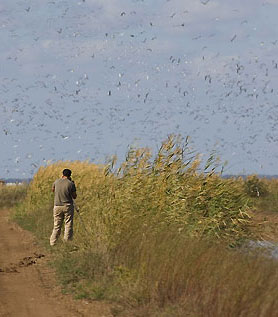
| Espartero stays in a very defined wintering area for more of a month in the southwest of Chad, near the border with Cameroon. This zone turns out to be a reserve of fauna and an Important Area for the Birds (IBA) defined by BirdLife International. |
Black Storks as bioindicators of habitats From 11th November our black stork is located in a same area, to the southwest of Chad, near the border with Cameroon. This place is a faunal reserve known as Binder Léré, established in 1974. This reserve is also an Important Area for the Birds (IBA) named by BirdLife International as “TD007 Binder Léré”, which confirms our idea that the Black Stork is an excellent bioindicator specie for habitats. Rocky and eroded grounds dominate the landscape of this zone. This is an interesting zone because it supposes a scope of transition of forests opened towards the savannah, dominating leguminous arboreal in the south (more adapted to the dryness), and forests of Combretum in the north. Anogeissus and Boswellia shrubs characterize the savannah. The Kébbi May river flows from the east to the west of the reserve, including the lakes Lére (14,5 km of length by 4 km wide) and Tréné (6 Kmx2 km), before continuing its route towards the west, to enter into Cameroon and Nigeria, where the fluvial network of the Niger river is gotten up. Just outside the reserve an extensive plain exists where Touboiris and Loké marshes are located. The annual precipitation average is between 800-950 mm. In this hydric complex of the system of Niger, in the heart of Africa, it is where the stork coming from the province of Salamanca decided to spend the winter.
In the surroundings of the reserve there are numerous towns and cultures, where millet is cultivated mainly, peanuts and cotton. The greater threats constitute the furtive hunters and the all-terrain vehicles, coming from Cameroon. Although, threatened African species of birds have been described in the zone, we have not had the news that this area has been defined previously important for the Black Stork, reason why Espartero could be keeping awake an important spot for the species in the heart of Africa.
Everything is information can be resisted and be extended in English in the following address of www.birdlife.org: [Link ] Situation map in [Link ]
Source: BirdLife International 2005 BirdLifés online World Bird Database: the site for bird conservation. Version 2.0. Cambridge, UK: BirdLife International. Available: www.birdlife.org (accessed 21/12/2005)
|