|
|
 |
 |
 |
| Trip to Andalusia in search of "Claude" and other tagged black storks from the project "Flying Over Natura 2000" (Part I) |
| Wednesday, 02 November 2005 |
A team from the project "Flying Over Natura 2000" formed by people of the project in France and Spain, and with the support of Cristina Parkes, the ranger from Junta de Andalucia Salvador Barea and a technician from Junta de Andalucia Jose Manuel Lopez locates the remains of the black stork "Claude" in the rocky area of Cadiz. |

Claude, the first death confirmed between the black storks marked within the project “Flying Over Natura 2000”. The members of the project "Flying Over Natura 2000" had the feeling that "Claude", a black stork born in the Czech Republic 4 years ago and marked in France beginning of September with one of emitters PTT of the project, could have death in the mountain range of Cadiz. The certain thing is that the signals sent by the emitter of "Claude" took from 29 of September locating it in the province of Cadiz, in a hilly place of near Jerez de la Frontera, apparently did not move. Between some members of the project the felt that was had "Claude" had passed away, although the members of the project in France had doubt of it. For this reason, the French colleagues and us organized to try to locate to Claude, or his transmitter (although improbable, she could lost it), or worst the emitter and its carcass.
At beginnings of week our French colleagues arrived, Claude and Annie Chapalain, two of the people in charge of the project in France, and that takes to several years doing the studies of the black storks in the department of Niévre, in the center of the country. During the week we were consulting to some Andalusian friends on the zone, analyzing the data, obtained cartography of the zone, we watched the ortophotos, we calibrated gps and we were verifying that scanners worked correctly. |
Searching for "Claude" Therefore, the past 29 of October we organized a trip to try to locate to "Claude" in the field. We had the essential aid and collaboration of Cristina Parkes, the ranger from Junta de Andalucia Salvador Barea Barea and a technician from Junta de Andalucia Jose Manuel Lopez.
The transmitter of "Claude" signaled a place away from any simple access road, within one of the immense property located in these areas. The beginning of the day search began complicated, since to have access to the property, was a sequence of requests of permission of person in person, that were extending the beginning of the search. We knew, that one of the greater stumbling blocks was to be able to access to the zone from where it emitted the transmitter. Finally at midday, we were able to accede to the property. The uncertainty began to seize of us, since we already were in the area that so many times we had studied and watched in the maps. With the aid of the maps and GPS, we were able to accede to the zone. It was in the surrpoundings of a stream, where certain clear of grass, acebuches (wild olive) and oaks trees were opened between a dense Mediterranean vegetation of, Terebinths and other typical shrubs of these atmospheres. According to GPS we had arrived at about 200 meters from where he was Claude. The certain thing is that to be in the zone, was almost impossible that it was with life, since the stream was completely dry, and was a very strange zone so that a black stork settled down itself to spend the winter. We had the fear that if it were between the vegetation, went to be very difficult to locate it or to even accede to him.
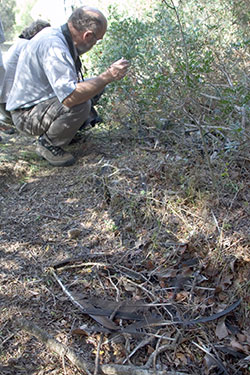
We put scanners on. Soon after, both scanners directed to us towards the stream, reason why we began to make a "search" all those that we were in the place. It was much more easy for us to look for by the zone of the stream that between the vegetation. After minutes search, finally we gave with the feathers and the transmitter of “Claude”. The rest of "Claude" were dough of feathers, some bone, the transmitter and the white PVC put by the Czech people four years ago. We inspected by eye the zone, where there were rest of wild boar, but were rest of no cartridges, no electrical lines, nor another signal that us could indicate a non-natural death of “Claude”. It had been a month in the place, probably dead, and few data we could extract from the field.
We tend to think that "Claude" could have arrived exhausted at this place in his migration. The day previous to the 29 of September, date in which it is located in this place, flew more than 200 km Could be that exhausted, food search of or water had settled in the surroundings of this stream in, and was it dry. Debilitated, it died or it was depredated. This is single a hypothesis, because we will never be able to know surely that it happened to him to "Claude".
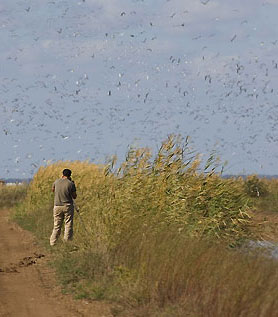
Satisfied by the fulfilled objective to know about "Claude", although of course displeased by its death, we left the zone, and we went to the marshes and ricefields of the Guadalquivir river, place where other two black storks of the project are located, apparently alive. |
© Photos: Alejandro Torés |
|
|
 |
 |
 |
 |
|